An Appetite for Failure

As teachers and parents, we spend most of our time helping children succeed. We support them, give them work that is challenging (but not too challenging), and if they fall, we are there to jump in and catch them before they hit the ground. Often, when students fail, they cry – and we feel terrible. We wonder, “what could I have done to teach the material better, to communicate their homework more clearly, or to give them more time or resources so this failure could have been avoided?”

But I wonder if we are doing children a favor in this regard. Take a break for a moment and check out this video produced by my creative heroes, OK GO. This isn’t my favorite OK GO video to watch, but what what I love about this video is the effort that went into creating it. In fact, there are many videos on the making of the video. In one of those, Damian Kulash, the lead singer of OK GO, talks about what he wanted from the video: “Hopefully it’s like, right on the edge of do-able. Hopefully we won’t nail it once and say, ‘aw, we could have made it better!’”

To me, this is a profound statement about vision. Vision is about seeing the long distance of what might be. It’s not about doing what’s already been done or making incremental changes or improvement. Vision is big and almost impossible. As such, one has to have an appetite for failure. For example, in the outtakes of the video above, one can see that it took them at least 215 takes before they finally got their shot. They knew going into it that they were going to fail their way to success.

A classic example of this “appetite for failure” comes from Thomas Edison, who, when asked about his trials and tribulations while attempting to invent the lightbulb, is widely quoted as saying, “I have not failed. I have successfully found 10,000 ways that will not work!”

I know I have had my failures, and I know how important persistence is on a personal level.  But I can’t remember when I tried doing anything 215 times without giving up. I wonder how my life might be different if I had that kind of persistence. Would I be able to fix my own computer problems? Could I rehab my own house? Could I have written that screenplay I dabbled with? Would I love playing basketball? Would I be a rocking guitarist? I imagine being a happier,  more successful person – not from being more talented, taller, or richer, but by being the kind of person who has a higher tolerance for failure.

One’s ability to face failure over and over again and proceed with faith, vigor, and vision is called persistence. Calvin Coolidge once said, “Nothing in the world can take the place of persistence. Talent will not: nothing is more common than unsuccessful men with talent. Genius will not; unrewarded genius is almost a proverb. Education will not: the world is full of educated derelicts. Persistence and determination alone are omnipotent.”

Are we as parents and educators allowing students to come up with ideas that are “on the edge of do-able?” Are we allowing our students to pursue them doggedly – allowing them to fail over and over again on their way to success? Are we pursuing the changes we want in our organizations and communities with an appetite for failure, or are our own discomfort,  impatience, and aversion to struggle impeding our abilities to change and grow? While we hyper-focus on giving kids the tools for success, are we offering them critical opportunities to learn from failure?

 

Shana Tova! Happy New Year!

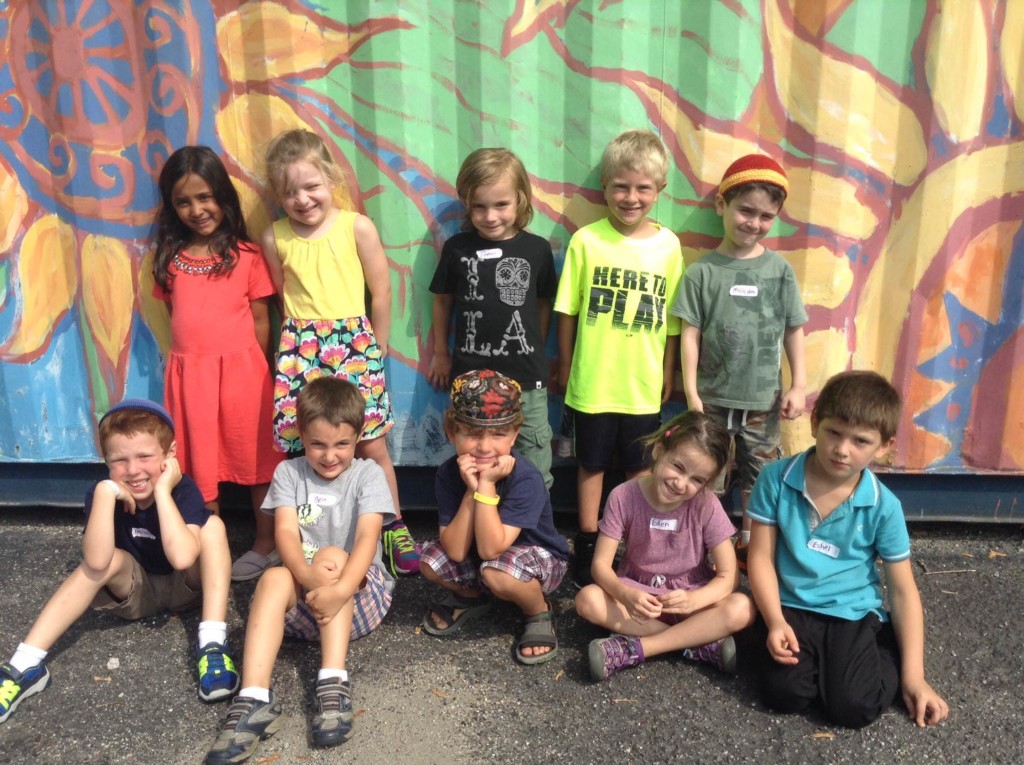
The students are super excited to reconnect with former classmates and to make new friends from Israel. We are pen pals with kids in Israel. Each student wrote a greeting card for a sweet and a happy new year in Hebrew. These cards by now are on their way to Israel….

Also, we are learning our first Zimriyah song, BaShana Haba’a (In the Upcoming Year.) A student asked me: “Can’t we just learn how to sing the songs without understanding the meaning of the words? I thought that the whole purpose of the Zimriyah is to entertain our parents and grandparents.”

My answer was that we use Zimriyah songs to teach Hebrew, to understand it, to use these words in speaking and writing, and to learn about the culture of Israel. The students’ interpretations for the first verse decorate the class walls.

Lehitraot,

Rotem


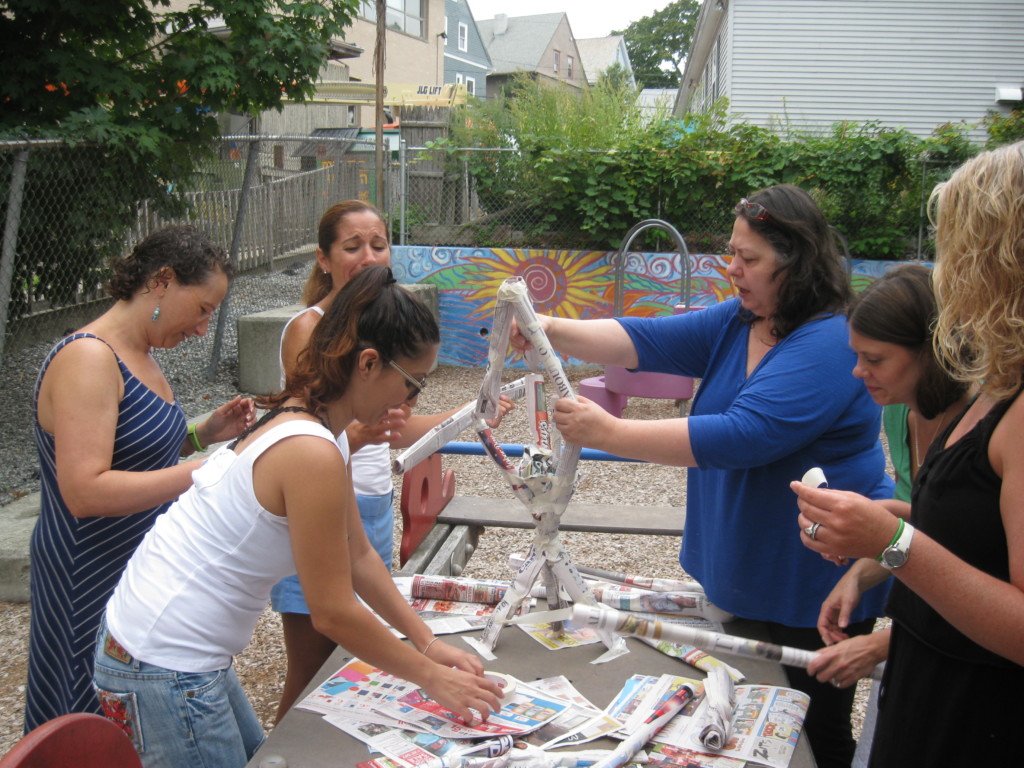
Let’s Design!

In order to create a useful product, designers need to understand how a user(s) feels about an object, system, or space. Therefore, our classes all started with empathy.

In third grade, we learned about empathy by taking part in a “leading the blind” activity. While one student was blindfolded, his or her partner led him or her across the room (without touching or redirecting!) to perform a very specific task. While blindfolded, each student needed to pick up a cylinder from across the room, turn around, go through a set of doors, and place the cylinder on a small table. Then, students switched roles. To conclude the activity, we talked about how it felt to be the person who was blindfolded, and how it felt to be the person who was leading. Thus, we learned that empathy is understanding how someone else feels.

The design thinking process also involves creativity! First, we explored what creativity is. In first grade, we used straws, sticky tabs, and paper clips to create anything that we wanted. We quickly realized that we had to utilize our creative juices to make many different things from the limited resources.

Work in progress:
PreK and Kindergarten students are learning about how everyone is creative, especially the bunny in Not A Box by Antoinette Portis!

We’re thinking about the question: How might second graders create time capsules so that they can feel surprised, happy, proud, and different when they open it a year later?

And finally: How might the fourth and fifth grade students improve the fourth grade meeting spot so that it is comfortable, inviting, spacious yet cozy, and promotes conversation?

First Week of School

(null)We did it! We had a fabulous first week of school! We started the year off with building routines. This helps us set a foundation for learning. And, boy did we have fun exploring the classroom and getting to know each other. We built cool creations with blocks, playdough, squigz, and Magnatiles. And, we even had time to start learning a Rosh Hashana song. This is a special group of Kindergarteners. I’m excited for what the year will bring.


My First Day

The 2015-2016 school year has started! After we met most of the people from last year, said goodbye and went up the stairs right in to the new class, we encountered new smells:  the smell of the fresh paint from the walls, the new carpets, markers in all colors, the floor cleaner and  polish – everything is clean and new, even more then Passover clean! Suddenly I heard someone call my name, again and again… and I realized that all eyes were on me, just waiting, listening. So I told myself, ”Come on, Sivan, you have to start to talk –  everyone is waiting for you – after all you’re the teacher!!!”

Yes, even I was so excited about the first day of school! But you know what? It was the most AMAZING experience, because I have the best class ever!!! 4th grade rocks!!!  – Sivan Amon


JCDSRI Students Save Animals’ Lives

Fire-huskyLast year, Jill Davis’ third grade class became very invested in their Animal Adaptations unit. They had direct experience with disabled animals, since their class pets Gizmo and Gili (bearded dragons) were missing a foot and a leg, respectively. When it came time for the students to choose another pet to adopt, they found Bugsy, a guinea pig who was being bullied by his peers in the shelter. Fearful that the shelter would have to euthanize him, the students begged Ms. Davis to give him a new home in their classroom.

In the spring, the students chose “Animals Around the World” as the theme for their annual Read-A-Thon. They lined up sponsors and spent the whole day reading, earning donations based on the number of pages or books they read throughout the day. At the end of the day, the third graders had raised almost $2,000! They researched animal rescue facilities to choose the recipients of their fundraising.

The kids decided to donate half of the money to the ASPCA and half of the money to the PAWS Humane Society in Charles City, Iowa. Recently, Ms. Davis and her students received a heartfelt thank you from Julie Taylor, the director of PAWS Humane Society. Ms. Taylor was floored by the generous donation, and shared that the students have indeed helped to save the life of a husky named Fire (pictured). The Charles City Press published an article about our fabulous class and their life-saving donation.

Ms. Davis is also thrilled that, with the assistance of the reporter in Charles City, our school is establishing partnerships with two other elementary schools in Iowa. Our students will be able to connect with their peers there as they learn about the differences between rural and urban communities.

Open Letter to my Staff Before the Most Profoundly Awesome Year Ever

Why do people hate their jobs?  Is it because their bosses are idiots and never listen to the employees?  Is it that their work is meaningless and gives them a feeling of emptiness and a wasted life? Is it that they have no power or autonomy to change whatever isn’t working in their place of work? Is it that the work is never-ending, causing pressure without any real reward or relief? One thing is clear – many people aren’t happy at work.

A 2014 Gallup poll showed that only 20% of workers feel engaged at work!  Only 18% of white collar employees said they had time for creative or strategic thinking at work.  

Unfortunately, schools are often no better than other white collar workplaces. Sure, we have the joy of working with children, but there are often relentless external pressures on teachers.  There may be fear of being creative, of taking initiative, of trusting one’s gut.  The educational system is not looking for whole human beings to teach students; it is looking for people to deliver content to students.  Blended learning and the flipped classroom, while brilliant and well intentioned, can diminish the role of the teacher and put more pressure on her to deliver the content as efficiently as the machine. It’s the story of John Henry versus the steam drill.

The common core, also the work of many intelligent and well intended people, is essentially meant to be a fail-safe so that every child, no matter how inept or ineffectual the teacher, will receive the bare minimum of everythinIMG_4433g they need to know.  Instead of honoring teachers, the Common Core often feels to teachers like it is robbing teaching of creativity, joy, and expertise, transforming teaching from an honored profession into a nearly robotic delivery system for curriculum developed in an ivory tower in Washington, DC.
While we are hyperfocusing on the standards, benchmarks and achievement of children we never really talk about the lives and careers of teachers! This is a shocking mismatch between what we know to be true and what we want to be true. Studies show that teachers have more impact on student learning than any other factor, including special services, facilities, curriculum or leadership. Our society is trying to circumvent the need for happy, talented, experienced teachers in the classroom.

How much do we know or care about teachers? Are they fulfilled? Are they listened to? Are they completely empowered and encouraged to make change? Do they have the time, resources, and trust to be creative and adventurous as they teach?  Are they valued as whole, complex people who are respected and admired for the difficulty and complexity of their work?  

I have a dream that JCDSRI will be a kind of utopian workplace. While competing financially with the big independent schools is impossible for a school our size, compensation does not have to be the most important factor in job satisfaction. What if all of our teachers knew they were respected and they were trusted and empowered to make changes to the school as they saw fit? What if teachers felt safe enough to admit their weaknesses and received high quality professional development to help them develop their craft? What if they were able to bring their own passions and interests to school? What if our school created a shared common vision of excellence that created the kind of unity and teamwork usually found on professional sports teams and in elite military units? What if staff meetings were so efficient we could end them early and with a feeling of accomplishment and success? What if teachers trusted and respected each other to the point that there were never feelings of competition and politicking?

How is such a thing possible?

I have a 3 part plan to begin creating this utopian workplace this year.

  1. Protocols for staff meetings

This year, we will be experimenting with various protocols at staff meetings to ensure they run smoothly, all voices are heard, and that all staff members feel responsible and have the authority to make changes to the school when they see the need.  We will begin by using the protocols and language of Holacracy. This will be a change in the way we operate, but I believe will help us hear each other better, make decisions faster, and get more done.

  1. Transparency of roles and projects

Every team in the school operates in its own ‘circle.’  For example, the Board, the PA, Marketing and Admissions, the general studies team, the Jewish studies team, the lower grades team, and the upper grades team each represent their own working group that is responsible for its own set of projects and goals.  We will be using an online platform to track what projects are open in which circle, and who is responsible for each aspect of a project.  Getting work done faster, with clarity, and clear goals and responsibilities is critical to having a resentment-free workplace.  

  1. Culture of Awesome

This is the most important element of our ability to change. We will be making many changes to the way we operate next year. One can approach this with dread and resentment – or with tenacity and optimism. Bringing this tenacity and optimism is not just a suggestion to make you feel better – it is a job requirement!  For our school to become a groundbreaking, teacher-centered, utopian workplace, we need everyone on board. This means being willing to have a growth mindset and embrace change.  It means having tolerance for some mess, confusion, and rapid experimentation.  And it means obliterating “Devil’s Advocate” from your vocabulary. We will become a school where each employee offers solutions rather than pointing out problems.

Each one of these points need further explanation, training, and experimentation, all of which will take place during teacher week.  Much like taking a trip, we have a destination in mind, but we will have to steer as we go. I hope that this vision of creating a teacher centered, positive, energetic, collaborative and holistic workplace feels as exciting to you as it does to me. Together we will make our school happier, healthier, profoundly innovative and awesome!


The Three Pillars of Excellent Elementary Education


The Jewish Community Day School of Rhode Island is a pluralistic Jewish Day School that provides an excellent general and Jewish education for children in Pre K through grade 5. After graduation, our students attend the finest public and private schools and thrive in their studies. They are knowledgeable Jewish leaders who go on to play active roles in community life as teenagers and adults.  But none of that is what makes JCDSRI special.

JCDSRI approaches our curriculum through three lenses: progressive education, joy and  meaning. Because we pursue these three values in everything we do, our students learn more, feel better, exhibit more leadership skills, and have more pride than in any other school we’ve experienced.  Our students skip to school every morning, hang out and play after school, and cry on the last day of school.  They love school, and here’s why.

Our school models progressive education, not traditional education. That means the teachers aren’t asked “to be the sage on the stage, but rather the guide on the side.” Students have a voice and power to help choose what they will learn.  Curiosity and creativity aren’t a nuisance at our school- they are the prime motivators of education, and we do everything in our power to build those skills.  Our students engage in Project Based Learning, so they are learning by doing, and they learn to collaborate with  peers to build critical communication, negotiation, organizational, and delegation skills they will use throughout their academic and professional careers.

Progressive education used to be seen as something countercultural – an alternative to the traditional frontal classrooms, in which teachers lectured and students absorbed knowledge.  These days, it is widely recognized that having student-centered classrooms in which the students are actively engaged, not just listening and copying, is simply good education. But unfortunately, old habits are hard to break, and many schools simply lack the courage, resources, or vision to commit to a truly progressive vision. Perhaps this is why, even with the plethora of fancy independent schools in Providence, JCDSRI is the only one with a design thinking class, the first to establish a Design lab (what some call a makerspace, STEAM lab, or Innovation lab), and is the ONLY school in Rhode Island with a partnership with the Brown/RISD STEAM group.  This partnership, named KinderSTEAM, has facilitated many workshops at JCDSRI directed by diverse leaders from undergraduates in industrial design at RISD to post graduates in applied mathematics at Brown.   JCDSRI’s design thinking program and lab was featured at the National Association of Independent School conference this winter, and has gained national attention, because at our school, progressive education isn’t just jargon- it affects everything from the way we set up our classrooms to the way we manage our classrooms to the way we partner with local universities.

The second lens that makes our school so unique is Joy.  We are acutely aware that we aren’t just responsible for teaching our students skills and content, but also for helping to form the joyous memories that will sustain our students for the rest of their lives. Life isn’t just something that happens when you get older – it’s happening right now, to each and every one of us.  We want our students to lead happy lives.  That means putting people before product.  We provide ample opportunities for field trips (we have our own bus), for recess, for community building, and for supporting the social and emotional growth of all our students.  It’s shocking how rarely joy and happiness are discussed in education these days – perhaps because it’s harder to create a standard, a benchmark, and a multiple choice test to measure for happiness. But we know that happy kids are more excited to participate, learn, fail, try again, and grow than kids who are sad, worried, or bored.  So we make sure school and learning are fun.

The third lens that makes JCDSRI special is our focus on meaning.  As a Jewish day school, we take our role as agents of Tikkun Olam seriously.  Our students use Jewish prayer and the holidays to reflect on the meaning of their lives and explore how they can be better friends, children, brothers, sisters, and community members.  We use the full range of our traditions and critical thinking skills to devise ways to make the world a better place.  Happiness is wonderful, but without meaning, it can become shallow and vacant.  Our school is grounded in our ancient tradition and our passionate belief in the power of community, purpose, and living an ethical, meaningful life.  This is too often overlooked – perhaps because of the separation of church and state, or perhaps because without a rich, shared tradition, finding the common texts and language in other schools is too hard to do.  But we know that creating deep roots in childhood helps our students to live more solid, grounded lives as adults.

JCDSRI is truly a unique school.  The warmth, vibrancy, and energy of our community continues to grow each year.  We welcome you to come for a visit and see for yourself.


Six Leadership Lessons from Your Family Vacation

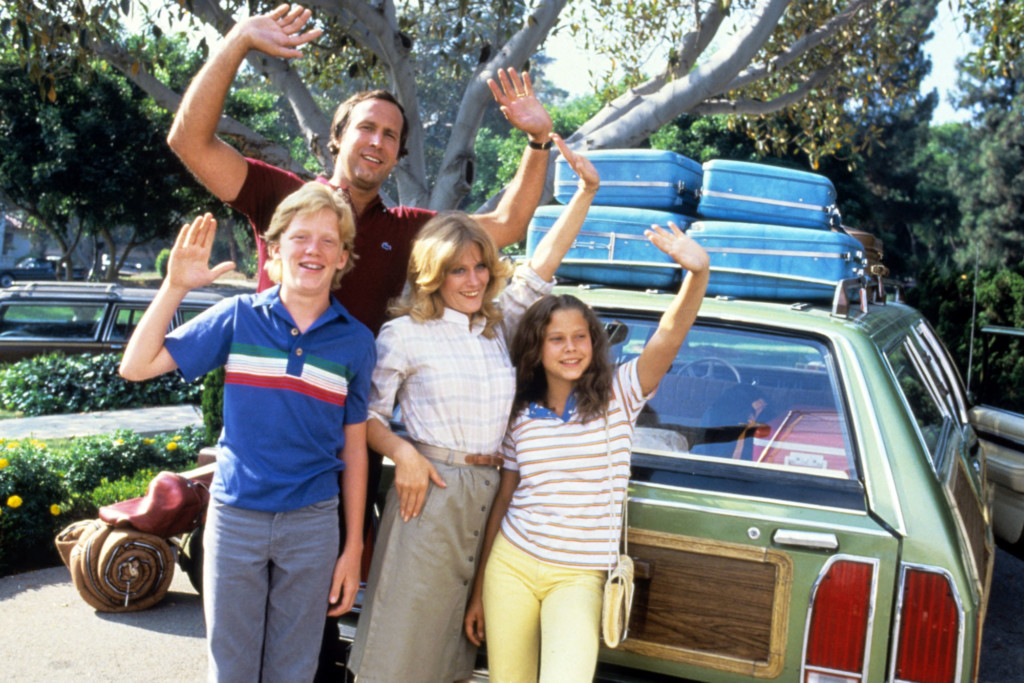
In many ways, leadership can be seen as taking a team on a journey. Sometimes it’s easiest to see complicated tasks through parables, and what could be more familiar than a family trip?

Imagine, summertime is here, and you have a surprise for your family. You pull up to the house in your brand new mini-van and call the family out to take a look. Your spouse nods with approval, having taken part in the decision. Your kids are excited to have a new car– the old one was so beat up.

NATIONAL LAMPOON'S VACATION, Anthony Michael Hall, Chevy Chase, Beverly D'Angelo, Dana Barron, 1983
NATIONAL LAMPOON’S VACATION, Anthony Michael Hall, Chevy Chase, Beverly D’Angelo, Dana Barron, 1983

“Pack your bags,” you grin, “We’re going on a trip!” The first question your family will ask is, “Where are we going?”  

Our first lesson in leadership is to know where you are going.  In other words, have a vision. Your family doesn’t want to pack their bags to drive in circles for two weeks.  They want to know where they are going, how long it will take to get there, and how to pack. Without a destination, expect an anxious and quickly frustrated family. A manager might be able to keep the status quo; a leader has to lead, and that requires having a vision, a goal, or a destination in mind.

“We are crossing this great country of ours, heading to California!” you announce proudly, expecting a shout of excitement. Your teenage daughter rolls her eyes.  Your 12-year-old son jumps for joy and says,“Yes! We’re going to Disney Land!” Your 9-year-old daughter says, “I have a soccer game on Thursday and Becky’s party is on Sunday!” Your 5-year-old son says, “How long is that going to take?” and your 3-year-old asks, “Can I bring toys?”

As you can see, lesson two is that people will react differently to your vision. Some people will love it and some will hate it; some will be skeptical, some curious, some optimistic and enthusiastic; some will want to stay mired in details rather than seeing the big picture; and others will think they understand your vision, but they actually don’t. All of their reactions are normal and should be addressed with confidence, patience and optimism.

You are trying to do something nice for your family and before you have even gotten everyone in the van, you are already encountering resistance. It might be tempting to ‘lay down the law,’ saying something like, “I’m the parent here, now do what I say!” This might be the quickest and simplest way to get things done- but does it get your family ready to enjoy a wonderful vacation? To build good memories and intimacy, it might be better to take a different approach.

“Ok, everyone,” you announce, “this trip is going to be great for all of us – because it’s not just about California, it’s about the trip! We are all going to get to pick places where we will stop along the way. Everyone is going to have a say and a choice to do something that is just for them.”  

Lesson three is to remember: It’s not just about the destination, it’s about the journey. Just as the success of your vacation depends on the happiness of your family, the success of your institution depends on the happiness of your employees. Happy employees work harder, spread optimism, and support you and your mission. Unhappy employees feed on each other’s negativity, spreading discord and rebellion.  On a cross country trip, do whatever you can to get the family singing together and not bickering in the back!

You get the buy-in from your family, they pack their bags, get in the van, and you are off! It’s a long trip—longer than you expected. You are committed to building trust and intimacy on your journey, to stopping along the way to meet the needs of individual family members, and to enjoying the ride. But it’s taking a long, long time. You think about skipping some stops on the itinerary, just to get there faster.

Lesson four: Change takes a long time. Sometimes you have to move slow to move fast. That means that even if  your family is tired of driving and you just want to get there already, you have to be very careful before you strike one of your kids’ planned stops from the itinerary. You might get to your destination faster, but at what cost? Will someone feel alienated, forgotten, or disrespected? How will that affect the family in the long term? Often it’s worth taking the extra time to make sure everyone gets his/her needs met, even if it takes a little longer.

You decide to take one extra day and visit an attraction that the whole family will appreciate. You wake up the next morning to discover that someone hit your car while you were all sleeping. It needs to be repaired.  The attraction will be closed by the time you get there. The family is cranky and fed up.  They are bickering with each other and everyone seems to think it’s all your fault.  Even your supportive spouse thinks you are botching things terribly. You have a speech prepared in your head that goes something like,“You lousy ingrates! I’ve done all of this for you, and none of this is my fault, and the least you could do is have a positive attitude or shut up!”

Lesson five is that you are the parent.  As a leader, and the one with real power in your institution, you are not allowed to react in anger. Absurd mishaps, unintended diversions, and personal conflicts will happen. When they do, remember that as a leader, you are being paid to be the adult. Your job is to be a good listener, remain positive, and look for solutions without resentment, blame or the need to be thanked. You might have good reasons to be frustrated, but it is your journey, and you have to see it through with unshakable optimism, faith, and responsibility. Allowing yourself to express anger won’t get you any closer to your destination, and it will undermine the point of your entire trip.

The final lesson in leadership from our hypothetical family vacation is to take care of yourself. Make time to exercise, eat well, and get plenty of sleep. If you skip meals, stay up late, and try to drive all day without a break, chances are much higher that you’ll fall asleep at the wheel, strain your back, or explode at a family member who asks a silly question. Leadership is an emotional job; it requires making difficult decisions and having intense conversations every day.  To be a great leader, you need to be at your best. No one deserves to deal with a tired, hungry, stressed, dehydrated, cranky you!  Never underestimate the relationship between your body and your brain, so make taking care of yourself a priority.

As you pull into the driveway of your home, you think back on your trip- not just on the destination, but on everything that happened along the way.  Your family is happier, stronger, and looking forward to the next adventure. Where do you want to go next?

Tomer’s Post about our Guest from Adidas

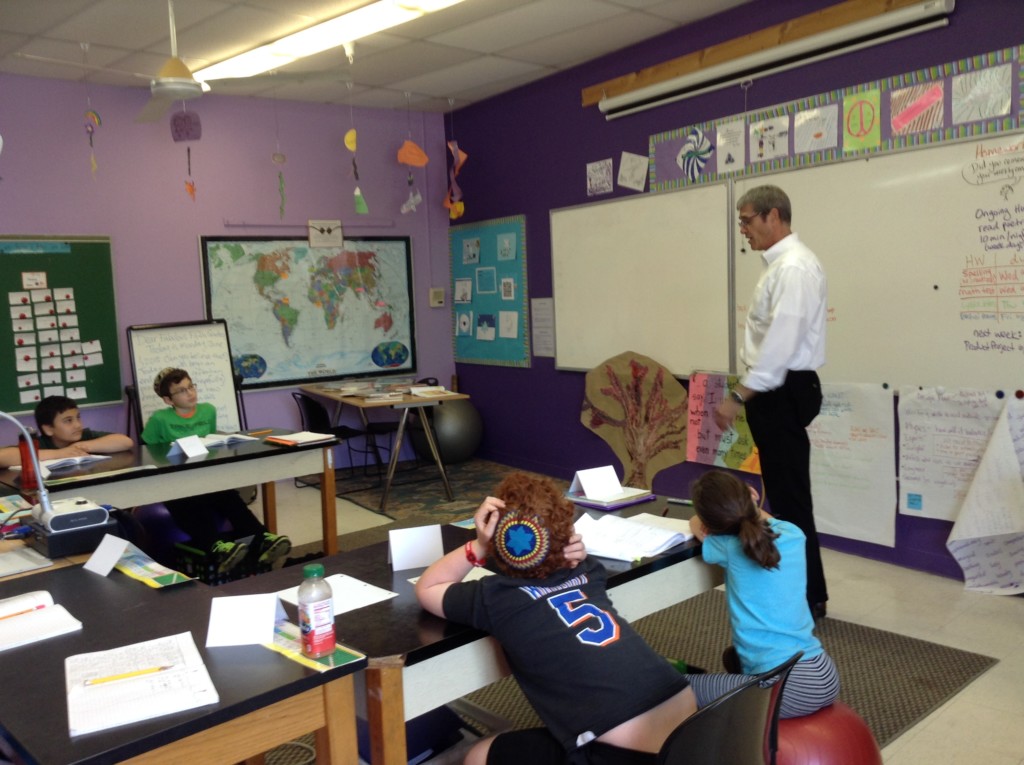
This week a very special guest speaker came to the fifth grade class.  Greg, a vice president of the company Adidas, came and talked to us about what he does as a vice president of such a large company.  As a vice president of a large company like Adidas, there are many responsibilities he has to take on.  Keeping factories clean and safe is hard, especially when there are almost two thousand factories to take care of in China, India, the Philippines, Thailand, Vietnam, Turkey.  80% of all Adidas’s products are made in those six countries.  He and his team make sure the workers are happy and get the money they earned, that the factory is safe, and that there are no children under the age of sixteen working.  If he finds any of theses things he may send them a letter saying that the owner of the factory has to fix the problem in a certain amount of time.  If the owner doesn’t do what he was told, they get another letter saying that they have to do it.  If they still don’t do it by the third time, Adidas will tell them they will not give them anymore work after a certain amount of time, so any raw materials already there can be produced into the product and so the workers will know that they won’t be employed in some time.  If what he and his team find is very bad, then they will just stop production immediately and never work with the factory again.   This is only a fraction of all that we learned from Greg about his job.

Adidas